
Financial Fraud Cases Involving Ksh 8.39 Billion Highlight Growing Risks In Banking And Financial Sector
By Admin Tuesday, 17th November 2026
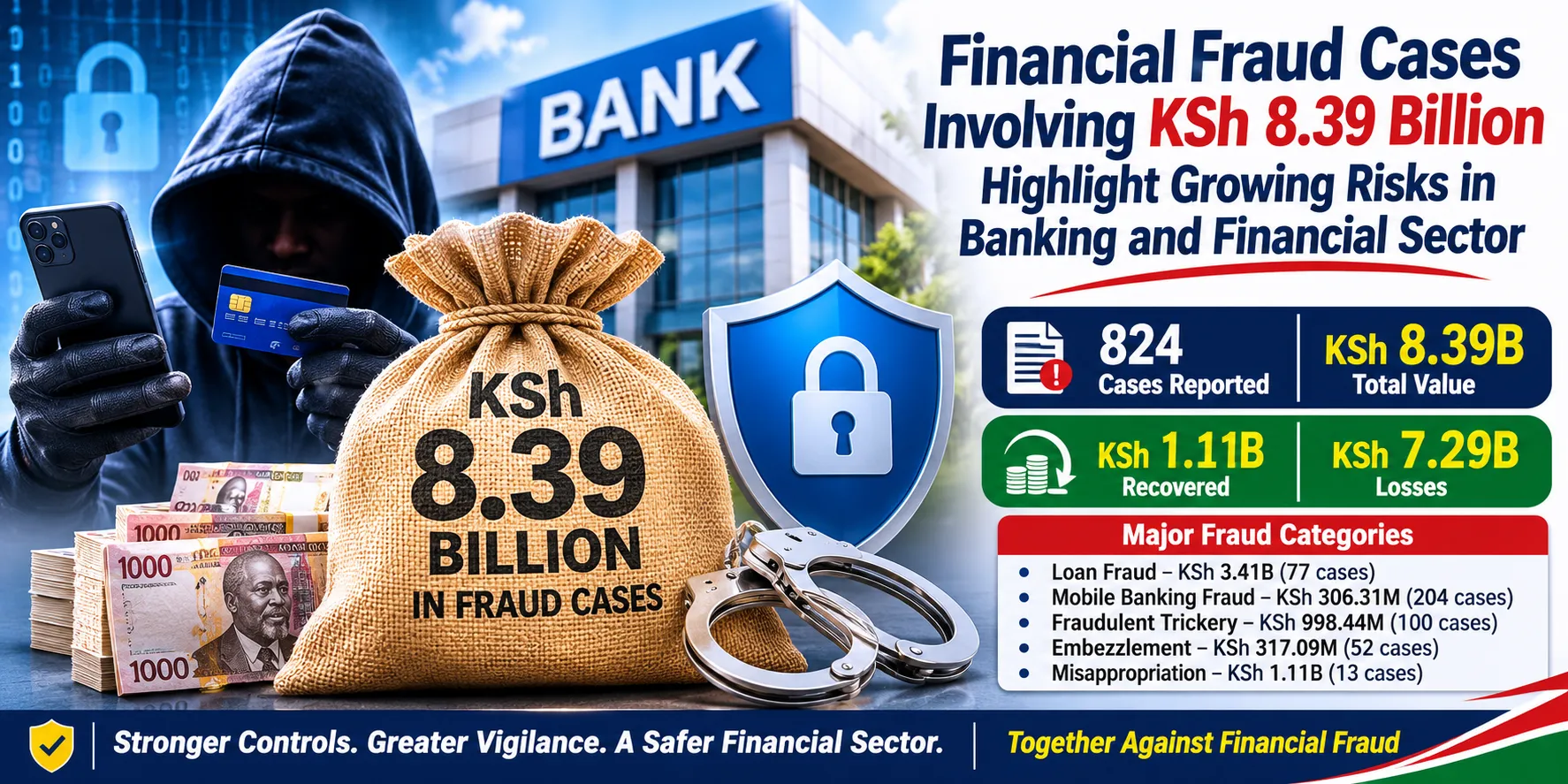
Photo courtesy: CAK
Financial fraud continues to pose a serious threat to the stability, integrity and public confidence of financial institutions, with reported cases involving KSh 8.39 billion highlighting the urgent need for stronger internal controls, enhanced surveillance and closer collaboration in combating financial crimes.
The scale of the challenge emerged during the 5th Annual Cabinet Secretary for Co-operatives and MSMEs Consultative Forum at Sawela Lodge, Naivasha, where David Siele, the second presenter, delivered a presentation titled “Frauds in the Financial Industry.”
His presentation examined emerging fraud trends, common financial crime schemes, investigation procedures and the role of the Banking Fraud Investigations Unit (BFIU), a specialised unit within the Directorate of Criminal Investigations (DCI).
Financial Fraud Remains a Growing Threat to Financial Institutions
Siele explained that crimes committed within the financial industry are broadly classified as fraud, with perpetrators generally falling into two categories: internal and external.
Internal fraud involves individuals who exploit their legitimate access to an institution's systems, resources and operations, while external fraud is perpetrated by individuals or groups operating outside the institution.
He emphasised that financial institutions must pay close attention to insider threats, noting that individuals with authorised access can expose organisations to significant financial and operational risks.
The presentation also outlined the mandate of the Banking Fraud Investigations Unit, which is responsible for conducting criminal investigations into offences committed within commercial banks and the wider financial sector.
Participants were taken through major fraud typologies, investigation procedures, statement recording, court processes and emerging threats affecting financial institutions.
KSh 8.39 Billion Involved in 824 Reported Fraud Cases
The fraud trend analysis presented by Siele revealed the significant financial exposure facing the banking and financial sector.
According to the figures presented, 824 cases were reported, involving approximately KSh 8.39 billion. Of this amount, approximately KSh 1.11 billion was recovered, while KSh 7.29 billion remained lost.
The figures demonstrate the enormous financial consequences of fraud and the challenges institutions face in recovering funds once fraudulent transactions have taken place.
The substantial gap between the amounts involved and the funds recovered also highlights the importance of preventive controls, early detection, timely reporting and effective investigative mechanisms.
For financial institutions, the implications extend beyond direct financial losses to include reputational damage, reduced customer confidence and potential disruption of operations.
Loan Fraud and Mobile Banking Fraud Dominate Reported Cases
Loan fraud and mobile banking fraud featured prominently in the analysis, although they differed considerably in the number of cases and financial value involved.
Loan fraud accounted for 77 cases involving approximately KSh 3.41 billion, making it the largest category by financial value. Recoveries amounted to approximately KSh 811.56 million, leaving an estimated KSh 2.60 billion in losses.
Mobile banking fraud, on the other hand, recorded the highest number of cases at 204, involving approximately KSh 306.31 million. Only KSh 2.02 million was recovered, leaving approximately KSh 304.29 million in losses.
Other significant categories included fraudulent trickery, which accounted for 100 cases valued at approximately KSh 998.44 million, and withholding erroneous payments, which involved 75 cases valued at approximately KSh 430.27 million.
Embezzlement accounted for 52 cases involving approximately KSh 317.09 million, while misappropriation involved 13 cases valued at approximately KSh 1.11 billion.
The figures highlight the different ways financial institutions are exposed to fraud, ranging from manipulation of lending processes and unauthorised transactions to the misuse of institutional resources.
Emerging Fraud Schemes and Digital Financial Risks
The presentation further highlighted the changing nature of financial crimes, particularly those facilitated by technology and increasingly sophisticated criminal schemes.
Mobile banking fraud was identified as one of the major areas of concern, with perpetrators employing techniques such as social engineering, identity theft, SIM swapping and account takeover.
These schemes often exploit weaknesses in digital security systems or manipulate customers into disclosing confidential information, which criminals subsequently use to gain unauthorised access to financial accounts.
Other emerging threats discussed included cybercrimes within the banking environment, business email compromise, computer fraud, internet banking fraud, card fraud and investment scams.
Siele also highlighted money laundering and its emerging links to virtual currencies, pointing to the increasing complexity of financial crime investigations in an evolving digital economy.
Investment scams accounted for nine cases involving approximately KSh 613.57 million, while business email compromise involved seven cases valued at approximately KSh 89.34 million. Computer fraud recorded five cases involving KSh 56 million.
These developments underline the need for financial institutions to continuously review their security systems and strengthen their capacity to identify and respond to emerging threats.
Low Recovery Rates Raise Concern
One of the key concerns emerging from the analysis was the relatively low recovery of funds across several categories of financial fraud.
Misappropriation, investment scams and fraudulent trickery recorded no recoveries in the figures presented. Mobile banking fraud also recorded very limited recoveries compared to the amounts involved.
Although loan fraud recorded recoveries of approximately KSh 811.56 million, the substantial outstanding losses across other categories demonstrate the difficulties associated with tracing and recovering funds after fraudulent activities have occurred.
The findings point to the importance of early detection and prompt reporting, as delays in identifying suspicious transactions can complicate investigations and reduce the chances of recovering stolen funds.
Financial institutions therefore need effective transaction monitoring systems, clear reporting procedures and coordinated responses whenever suspected fraud is identified.
Strengthening Fraud Prevention, Internal Controls and Accountability
The presentation reinforced the importance of recognising that financial fraud is not exclusively an external threat. Weak internal systems, inadequate oversight and the actions of individuals within financial institutions can also expose organisations to significant risks.
For co-operative societies, SACCOs and other financial institutions, the emerging trends provide important lessons on the need to strengthen internal controls, protect customer information, enhance transaction monitoring and promote accountability at every level.
Institutions should also continuously review access privileges, strengthen approval procedures, conduct regular internal audits and ensure that suspicious transactions are investigated promptly.
As financial institutions increasingly embrace digital platforms to improve service delivery and operational efficiency, investment in robust security systems and continuous staff and member awareness becomes essential.
The discussions at the Naivasha forum underscored the need for financial institutions to remain alert to evolving fraud schemes, strengthen collaboration with investigative agencies and adopt proactive measures to safeguard members' funds and institutional resources.
For the Co-operative Movement, protecting members' savings and institutional resources requires more than sound financial management. It calls for effective governance, responsible leadership, strong internal controls and a culture of accountability.
Building a resilient and accountable Co-operative Movement therefore requires institutions to remain vigilant, invest in effective fraud prevention systems and strengthen their capacity to detect, prevent and respond to financial crimes.