Why Kenyas Coffee Debt Fell From Sh11 Billion To Sh6.8 Billion And What It Means For Co-operatives
By Admin Tuesday, 25th August 2026
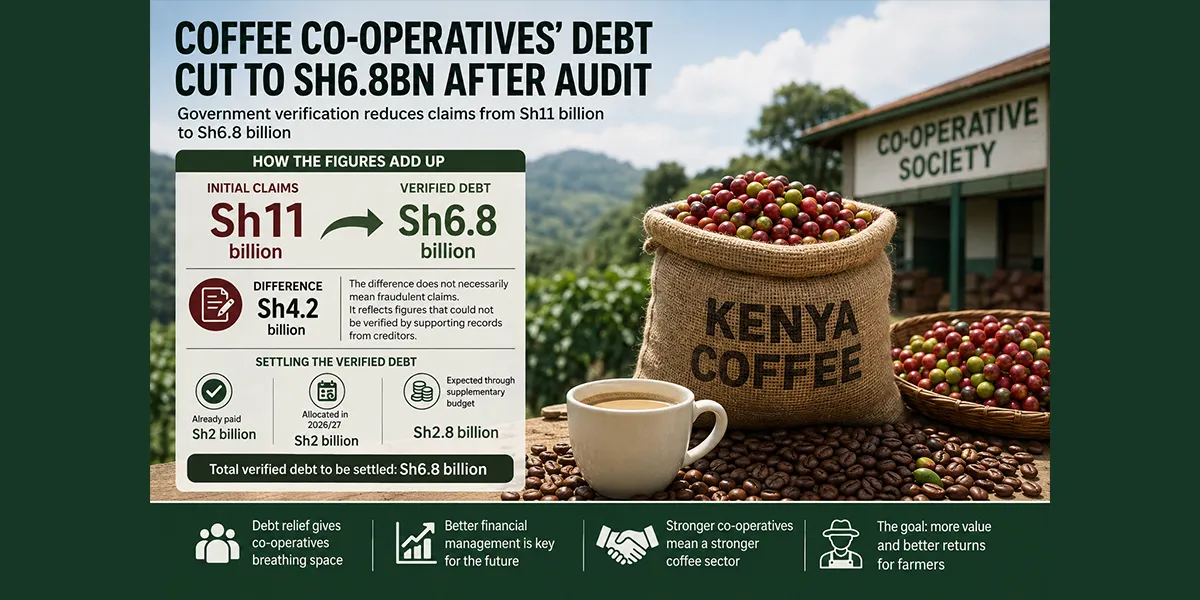
Photo courtesy: Photo courtesy
For years, debt has been one of the biggest challenges facing Kenya’s coffee co-operatives. Loans taken to finance processing equipment and other operations have left some societies struggling to meet their obligations to financial institutions. Now, a government verification exercise has changed the picture significantly.
Claims that had placed the coffee sector’s debt at about Sh11 billion have been reduced to Sh6.8 billion after an audit and verification process. The exercise was aimed at establishing which debts were genuine and could be supported by records from the institutions involved.
At first glance, the biggest story may appear to be the Sh4.2 billion difference. But the more important question is: why did the figure change so dramatically, and what does the verified Sh6.8 billion mean for coffee co-operatives and farmers?
From Sh11 billion to Sh6.8 billion
The original claims submitted by coffee co-operatives and other stakeholders amounted to approximately Sh11 billion. However, the government did not simply accept the claims at face value.
The verification involved comparing information submitted by coffee co-operative societies with records held by creditors, including commercial banks and other financial institutions that had provided loans to the sector. According to Commissioner for Co-operatives Development David Obonyo, the reduction should not automatically be interpreted as evidence that the difference represented fraudulent claims. Instead, the government wanted to establish which debts could be confirmed through supporting records.
That distinction is important.
A co-operative may report that it owes a particular amount, but the amount appearing in its records may not always match the balance recorded by a lender. There can be differences arising from repayments, interest, restructuring, previous settlements, accounting records or incomplete documentation.
The verification therefore provides a more reliable figure for the government to work with.
Why the verification matters
Without verification, the government could potentially commit public money against claims that had not been independently confirmed.
For example, if a society claimed that it owed a financial institution Sh200 million, government officials needed to establish whether the lender's records supported that figure. The process was therefore not simply about determining how much money co-operatives said they needed, but how much debt could actually be established.
This is particularly important because the government is using public resources to help settle the verified debt.
The Sh6.8 billion figure therefore becomes more than an accounting number. It is the amount that the government has identified as the debt requiring settlement under the current programme.
What happens to the Sh6.8 billion?
The government has already started addressing the verified debt.
According to the latest information, Sh2 billion of the verified amount has already been settled. Another Sh2 billion has been allocated in the 2026/27 financial year to continue settling obligations to financial institutions. A further Sh2.8 billion is expected through a supplementary budget to clear the remaining balance.
If these allocations are fully implemented, the government will have a pathway to clear the entire verified amount.
But payment of the debt is only one part of the story.
The bigger issue is what happens to coffee co-operatives after the debt burden is removed.
Debt relief could give co-operatives breathing space
For a co-operative society, heavy debt can affect almost every part of its operations.
Money that could have been used to improve coffee processing, maintain equipment, pay suppliers or invest in better services may instead go towards servicing loans.
Debt can also make financial institutions more cautious about lending to an organisation. A heavily indebted society may find it difficult to obtain new financing even when it has viable business opportunities.
Clearing verified historical debt could therefore give affected co-operatives room to rebuild their financial position.
It could also create an opportunity for societies to rethink how they finance their operations.
But debt clearance does not solve every problem
It would be a mistake to assume that paying the Sh6.8 billion automatically fixes Kenya’s coffee sector.
The sector has faced broader concerns around farmer earnings, management of co-operatives, access to finance, processing capacity and the overall value chain.
Historical debt may be one problem, but it is not necessarily the only reason some coffee farmers have struggled.
The government’s verification process itself was partly driven by concerns raised by farmers and other stakeholders about the financial challenges affecting the sector.
That means the debt settlement should ideally be followed by stronger financial management.
If co-operatives return to accumulating unsustainable debts, the current intervention could eventually become another temporary solution.
The real test is what happens next
The most important question for farmers is not simply whether the government has verified the debt.
It is whether clearing the debt will translate into stronger and more sustainable coffee businesses.
Co-operatives will need to demonstrate that they can manage their finances more effectively, keep accurate records and make borrowing decisions based on realistic business plans.
Financial institutions will also need confidence that loans extended to co-operatives can be repaid.
For farmers, the expected benefit should ultimately be visible through a healthier coffee value chain rather than simply through government announcements.
What the Sh4.2 billion difference teaches us
Perhaps the biggest lesson from the audit is the importance of accurate financial records.
The difference between the Sh11 billion initially reported and the Sh6.8 billion verified amount shows why large financial claims should be supported by documentation and independently checked before public funds are committed.
For co-operative societies, this should reinforce the importance of maintaining accurate loan statements, audited accounts, agreements with lenders, payment records and other supporting documents.
Good records are not merely an administrative requirement. They can determine whether a society can successfully defend its financial position when disputes arise.
A new opportunity for coffee co-operatives
The government’s intervention presents an opportunity for affected coffee co-operatives to start from a stronger position.
Once legitimate historical debts are cleared, societies can focus more attention on their core businesses: serving farmers, improving coffee production, strengthening processing and finding better ways of accessing markets.
But the success of the programme will ultimately depend on what happens after the debt is settled.
The Sh6.8 billion should therefore not be viewed as the end of Kenya’s coffee debt problem. It should be viewed as a chance to address the financial weaknesses that allowed the problem to grow in the first place.
For coffee farmers, the hope is straightforward: if historical debt is removed, co-operatives should become financially healthier, more accountable and better positioned to support the people who produce the coffee.
The audit has established a new number — Sh6.8 billion.
The bigger challenge now is ensuring that this figure becomes the starting point for a stronger coffee co-operative sector, rather than simply another government debt bill waiting to be settled.