
Sustainability Is No Longer Optional For Co-operatives, Mercy Akoth Adero Tells Leaders
By Admin Tuesday, 8th September 2026
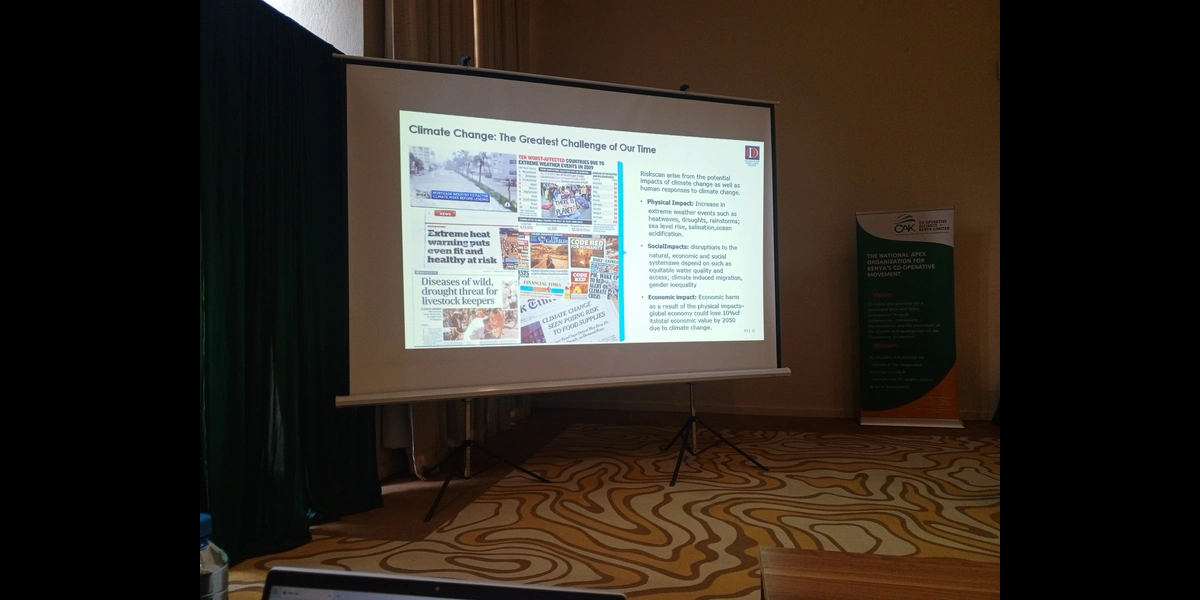
Photo courtesy: Photo courtesy
SACCOs and co-operative societies can no longer treat sustainability, environmental, social and governance (ESG) issues as peripheral matters. They must increasingly place them at the centre of their strategies, risk management and governance if they are to remain sustainable and relevant in a changing financial and business environment.
This was the key message delivered by Mercy Akoth Adero during the third day of the Future-Ready Co-operatives and SACCOs Leadership Forum, where she challenged co-operative leaders to understand and respond to emerging ESG and climate-related trends.
Adero noted that to remain sustainable, SACCOs and co-operatives must align themselves with emerging ESG trends. The pressure is no longer coming from one direction. Regulators, lenders, investors, members, consumers and communities are increasingly interested in how institutions manage environmental, social and governance issues.
According to Adero, capital is increasingly following ESG and climate performance, meaning that institutions that demonstrate responsible and sustainable practices could be better positioned to access and retain financial support.
At the same time, she warned that community and consumer trust is already at stake.
For SACCOs, which depend heavily on the confidence of members, trust is particularly important. Poor governance, weak accountability or failure to manage emerging risks can quickly damage an institution's reputation and ultimately affect its sustainability.
Responsible banking offers a useful framework
Adero pointed to the Principles for Responsible Banking as an important framework for institutions seeking to embrace sustainable finance.
The framework highlights several important areas, including:
- Alignment – ensuring that an institution's strategy supports broader sustainability goals.
- Impact and target setting – understanding the institution's impact and establishing measurable targets.
- Clients and customers – considering how financial services affect and support customers.
- Stakeholders – engaging the people and groups affected by the institution's activities.
- Governance and culture – building responsible practices into leadership, decision-making and institutional culture.
- Transparency and accountability – being open about performance, commitments and progress.
For co-operatives and SACCOs, the principles provide a way of looking at sustainability beyond simply protecting the environment. ESG should be connected to how the institution is governed, how it treats members, how it manages risks and how it makes strategic decisions.
ESG is everyone's responsibility
One of the key messages from Adero's presentation was that ESG cannot be left to one department or one officer within a SACCO or co-operative.
“ESG is a whole-institution's job, not one office,” was the message to leaders.
This means boards, management, employees and other stakeholders all have a role to play. ESG considerations should be incorporated into everyday decision-making rather than being treated as a separate project handled by a designated officer.
For boards in particular, ESG and climate governance should be viewed as a strategic responsibility.
Adero challenged leaders to ask a fundamental question:
Can we detect ESG and climate risks within our institution and among our members?
The question is important because risks may not always be immediately visible. Climate change, changing consumer expectations, data and technology risks, social issues and governance weaknesses can all affect the ability of a co-operative to operate sustainably.
Boards must take responsibility for ESG and climate risks
Adero emphasised that ESG and climate governance should form part of the board's strategic responsibilities.
Boards should therefore understand the risks facing their institutions and ensure that management has appropriate systems for identifying, assessing and responding to them.
This requires moving beyond viewing ESG as a compliance exercise.
Instead, it should be incorporated into strategy, risk management and decision-making.
For SACCO leaders, this means asking whether the institution's existing strategy adequately considers emerging environmental, social and governance risks and whether those risks could affect its members, operations, finances and long-term survival.
What gets disclosed gets scrutinised
Another important area highlighted by Adero was sustainability reporting, disclosure and stakeholder accountability.
Her warning was simple: what gets disclosed gets scrutinised.
As co-operatives increasingly communicate their sustainability performance to members, regulators, lenders and other stakeholders, the quality of that information becomes important.
Boards therefore have a responsibility to ensure that ESG reporting is:
- Material – focusing on issues that genuinely matter to the institution and its stakeholders.
- Accurate – ensuring that information presented reflects the institution's actual performance.
- Independently assured – where appropriate, having reported information independently reviewed or assured to strengthen credibility.
Sustainability reporting, therefore, should not become an exercise in producing attractive statements without evidence. The information disclosed must be reliable enough to withstand scrutiny.
Avoiding common mistakes in sustainability reporting
Adero also challenged co-operatives to avoid approaching sustainability reporting as an exercise undertaken simply because it has become fashionable or because regulators and stakeholders are demanding it.
One way of avoiding common mistakes is to integrate ESG into strategy and risk management.
She highlighted three important steps that institutions can take:
1. Establish the ESG baseline
A SACCO needs to first understand where it currently stands. This involves identifying its existing environmental, social and governance practices, risks and gaps.
2. Conduct a materiality assessment
Not every ESG issue will have the same importance to every institution. A materiality assessment helps a SACCO identify the issues that could have the greatest impact on its operations and stakeholders.
3. Define risk appetite
Once significant risks have been identified, the institution needs to determine the level of ESG and climate-related risk it is prepared to accept and how those risks will be managed.
The future-ready SACCO
The discussion placed ESG firmly within the broader conversation about building future-ready co-operatives and SACCOs.
For Adero, sustainability is not simply about preparing reports or adopting new terminology. It is about whether an institution has the governance structures, strategy, culture and risk-management systems needed to remain resilient as the operating environment changes.
For SACCOs, the message is particularly significant because their sustainability ultimately depends on the confidence of their members and other stakeholders.
A future-ready SACCO must therefore be able to answer difficult questions: What ESG and climate risks are we facing? Can we identify them early? Are they reflected in our strategy? Is the board providing adequate oversight? And can we stand behind the information we disclose to our stakeholders?
As the co-operative movement looks towards the future, Adero's presentation offered a clear reminder: ESG should not be treated as an additional responsibility sitting on the side of the business. It must become part of how the entire institution thinks, governs, manages risk and creates sustainable value.