Demystifying Taxation Requirements And Compliance For Cooperatives
By Admin Monday, 7th September 2026
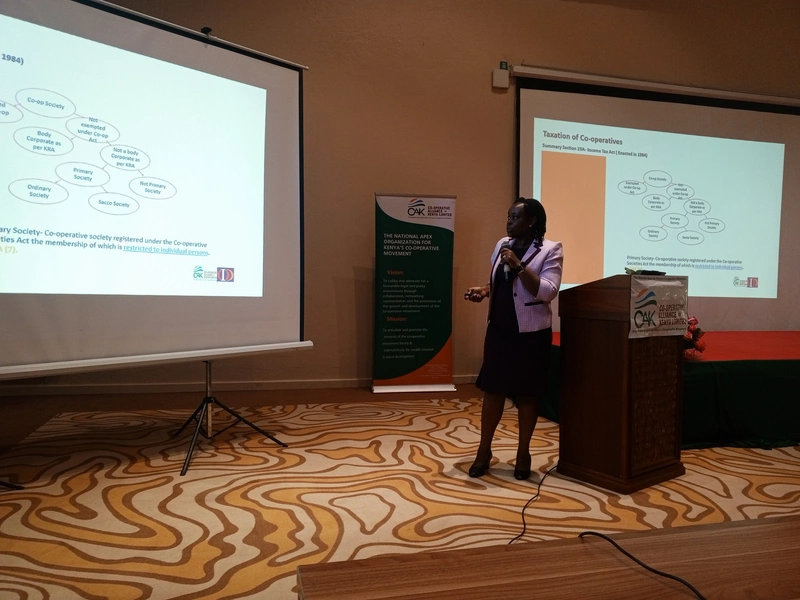
Photo courtesy: Photo courtesy
For many co-operatives and SACCOs, taxation can feel like a moving target. There is often uncertainty about which income is taxable, which income qualifies for special treatment, how membership affects tax computation, whether FOSA income is taxable, and how expenses should be apportioned.
Yet the tax position of a co-operative does not have to be mysterious.
At the Co-operative Alliance of Kenya Future-Ready Co-operatives Leadership Forum, taxation emerged as an important governance issue. The message is simple: co-operatives need to understand the tax rules governing their particular structure and activities, rather than assuming that everything they earn is either exempt or fully taxable.
The starting point is the Income Tax Act, particularly Section 19A, which provides a specific framework for the taxation of co-operative societies.
1. The first misconception: “A SACCO is a mutual society, so its income is tax-free”
This is perhaps one of the biggest misconceptions.
A SACCO is established to serve its members, and the principle of mutuality is central to the co-operative model. But mutuality does not automatically mean that every shilling earned by a SACCO is exempt from tax.
The courts have repeatedly distinguished between income arising from the mutual relationship among members and income generated from commercial activities.
The Nyeri Teachers Sacco v Commissioners of Domestic Taxes decision, for example, dealt with FOSA and sundry income and affirmed that a mutual society can also undertake commercial activities whose income is taxable.
This distinction is becoming even more important as SACCOs expand beyond traditional savings and lending.
Today, a SACCO may operate FOSA services, earn commissions, invest surplus funds, own property, provide additional services and transact with entities that are not individual members.
Each income stream needs to be examined on its own character.
2. Membership matters more than many SACCOs realise
Section 19A defines a primary society as a co-operative whose membership is restricted to individual persons.
This seemingly simple definition has major tax implications.
What happens when a SACCO that has traditionally considered itself a primary society admits a corporate entity, a group, church, school, CBO or another non-individual member?
This question has now been tested before the Tax Appeals Tribunal.
In Invest & Grow Sacco v Commissioner of Domestic Taxes, decided on 27 November 2025, the Tribunal considered a SACCO with individual and non-individual members. It held that income from individual members should be dealt with under Section 19A(4), while income attributable to corporate membership falls under Section 19A(2). The Tribunal described the SACCO's tax character as a mixture of a primary co-operative society and a designated co-operative society.
The practical lesson is significant:
A SACCO cannot simply look at its registration certificate and stop there. It must understand who its members are and how its income arises.
Membership records therefore become part of the tax story.
3. FOSA income is not automatically protected by mutuality
FOSA has transformed the way many SACCOs serve their members.
But FOSA has also created one of the most persistent areas of tax controversy.
Income from services such as commissions, transaction-related charges and other commercial activities can fall outside the core mutual relationship.
The courts have previously considered FOSA income taxable where the activity was commercial in nature. The Nyeri Teachers Sacco decision is an important reference point in this area.
This does not mean that every FOSA transaction should simply be labelled taxable without analysis.
It means that SACCOs should be able to demonstrate:
- What service generated the income?
- Who received the service?
- Was the transaction with a member or non-member?
- What costs were incurred in generating that income?
- How has the income been recorded?
- What provision of the tax law governs its treatment?
Good tax compliance therefore begins with good accounting and documentation.
4. The law already provides a special formula for qualifying SACCO income
For a designated primary society carrying on the business of a credit and savings co-operative society, Section 19A(4) provides a specific method for determining income subject to tax.
Among other things, it provides that taxable income includes 50% of gross interest income other than interest from members, together with specified property income, chargeable gains and other income chargeable under the Act.
That is an important distinction.
The provision does not simply say:
“Tax all interest.”
Nor does it say:
“SACCO interest is exempt.”
The law creates a specific treatment.
This is why SACCO boards, management teams and finance departments need to understand the source and nature of each income stream before calculating tax.
5. The corporate-member issue is no longer theoretical
The recent case law should be a wake-up call for SACCOs that have mixed membership.
In Invest & Grow, the Tribunal specifically found that a SACCO with individual and corporate members needed to separate the income associated with those different categories.
A similar issue was considered in the Imarika Savings and Credit Cooperative Society Limited v Commissioner of Domestic Taxes litigation. The case involved a SACCO whose membership was reported as approximately 97% individual and 3% non-individual. The Tribunal again considered the consequences of mixed membership and the application of Sections 19A(2) and 19A(4).
This points to a practical requirement for SACCOs:
Know your membership composition and be able to trace income to the relevant category.
If the accounting system cannot distinguish the income earned from different categories of members, a SACCO may struggle to defend its tax computation during an audit.
6. What about expenses?
Tax disputes are not only about income. They are also about expenses.
A SACCO may incur salaries, rent, technology costs, audit fees, marketing expenses, utilities, professional fees and other operational costs while generating different categories of income.
The question then becomes: which expenses relate to which income?
This is where expense apportionment becomes important.
Where an expense relates directly to taxable income, the SACCO should have evidence supporting that connection.
Where an expense supports several activities, the SACCO should have a reasonable, consistent and defensible basis for apportionment.
The absence of a clearly documented methodology creates room for disputes.
The recent SACCO tax litigation demonstrates why this matters. In the Invest & Grow case, the Tribunal considered the question of expenses after determining how the SACCO's different income streams should be treated.
The answer is not to create an allocation merely when KRA arrives.
The allocation methodology should exist before the audit.
7. Can the Commissioner simply decide that a SACCO is operating for profit?
This is another sensitive area.
Section 19A allows the Commissioner, having regard to factors including the number of members, nature of business, manner in which the business is conducted and extent of transactions with non-members, to form an opinion that a society is a body corporate carrying on business for its own profit.
This gives the Commissioner significant powers.
But those powers must still be exercised within the law.
For co-operatives, this means the board should not wait for a dispute before understanding how its membership structure, activities and transactions affect its tax position.
A future-ready co-operative should be asking these questions internally:
Are our membership records accurate?
Are we transacting with non-members?
Are we generating income outside our traditional member-based activities?
Can we explain our tax computation from the underlying accounting records?
8. Self-assessment means the responsibility is with the co-operative
Tax compliance is not simply about responding when KRA sends an assessment.
Kenya operates a self-assessment system under which taxpayers are expected to declare their income and determine their tax liability.
For corporate taxpayers, the income tax return is generally due within six months after the end of the accounting period. KRA also provides for instalment tax where applicable.
For a SACCO, therefore, the annual tax return should be the result of a proper internal process:
transactions → accounting records → classification of income → allowable expenses → tax computation → review → filing → payment.
A signed set of financial statements alone is not a substitute for a sound tax computation.
9. Compliance goes beyond income tax
One of the dangers of talking about “SACCO taxation” as if it were a single tax is that other obligations can be forgotten.
Depending on its activities, a co-operative may have obligations relating to:
- Income tax
- Withholding tax
- PAYE
- VAT
- Instalment tax
- Other applicable taxes and statutory deductions
KRA's published guidance, for example, provides that PAYE is generally due by the 9th day of the following month, while VAT is generally due by the 20th day of the following month and corporate income tax returns within six months after the accounting period.
Withholding tax is particularly important because a SACCO can become responsible for deducting and remitting tax when making certain payments.
And compliance is increasingly becoming a data issue.
KRA has stated that from the 2026 year of income, declared income and expenses are expected to be supported by valid electronic tax invoices generated and transmitted through eTIMS/TIMS.
For SACCOs, this means tax compliance cannot remain the responsibility of the accountant alone.
It must involve finance, procurement, operations, IT, management and the board.
10. Dividends and bonuses require proper treatment
Co-operative societies also need to understand the tax treatment of dividends and bonuses.
KRA's guidance states that dividends and bonuses paid by qualifying co-operative societies may be deducted in determining taxable income, subject to the conditions in the law. KRA further indicates that dividends are subject to withholding tax, while bonuses are subject to PAYE treatment.
This is an area where documentation matters.
The approval process, declaration, payment and accounting treatment should all be properly supported.
A board should be able to answer a straightforward question:
How did we arrive at the amount declared to members, and how was the associated tax obligation handled?
11. What should a future-ready SACCO do differently?
Tax compliance should not be treated as an annual emergency.
A future-ready SACCO should establish a tax governance framework that includes:
1. A clear tax responsibility matrix
Everyone should know who is responsible for each tax obligation.
2. Proper classification of income
Interest, commissions, FOSA income, rent, investment income and other receipts should not be lumped together without analysis.
3. Membership-based income tracking
Where a SACCO has individual and non-individual members, the accounting system should support appropriate separation of income.
4. A documented expense-apportionment policy
The methodology should be reasonable, consistently applied and supported by records.
5. Regular tax health checks
Do not wait for a KRA audit to discover five years of unresolved issues.
6. Strong documentation
Invoices, contracts, payment records, member records, approvals, financial statements and tax computations should tell the same story.
7. Board-level oversight
Tax should be treated as a governance and risk issue, not merely an accounting function.
12. The bigger lesson for the co-operative movement
The taxation debate is ultimately bigger than the question of how much tax a SACCO should pay.
It is about clarity, fairness and predictability.
Co-operatives need a tax framework that recognises their unique member-owned model while also acknowledging that many modern co-operatives operate sophisticated commercial businesses.
KRA, regulators, tax professionals and the co-operative movement therefore have an important role in creating greater clarity around areas such as mixed membership, FOSA activities, expense apportionment and the definition of SACCO business.
Recent litigation shows that these are not academic questions. SACCOs are already defending significant tax assessments before the courts and Tax Appeals Tribunal. In one High Court matter involving Stima DT Sacco, the disputed assessment covered principal tax, penalties and interest amounting to more than KSh435 million.
The cost of misunderstanding tax law can therefore be enormous.
But so is the opportunity.
A future-ready co-operative should not fear taxation. It should understand it.
When boards understand the rules, management maintains accurate records, accountants apply the law consistently and members appreciate how the co-operative is taxed, tax compliance becomes part of good governance rather than a crisis that appears when an assessment lands.
The goal should not simply be to pay the right amount of tax.
It should be to have the right records, the right processes and the right explanation to support that amount.
That is what tax readiness should mean for Kenya's co-operative movement.