
Building Trust: The Place Of Forensic Audit In Enhancing Trust In The Co-operative Movement
By Admin Monday, 7th September 2026
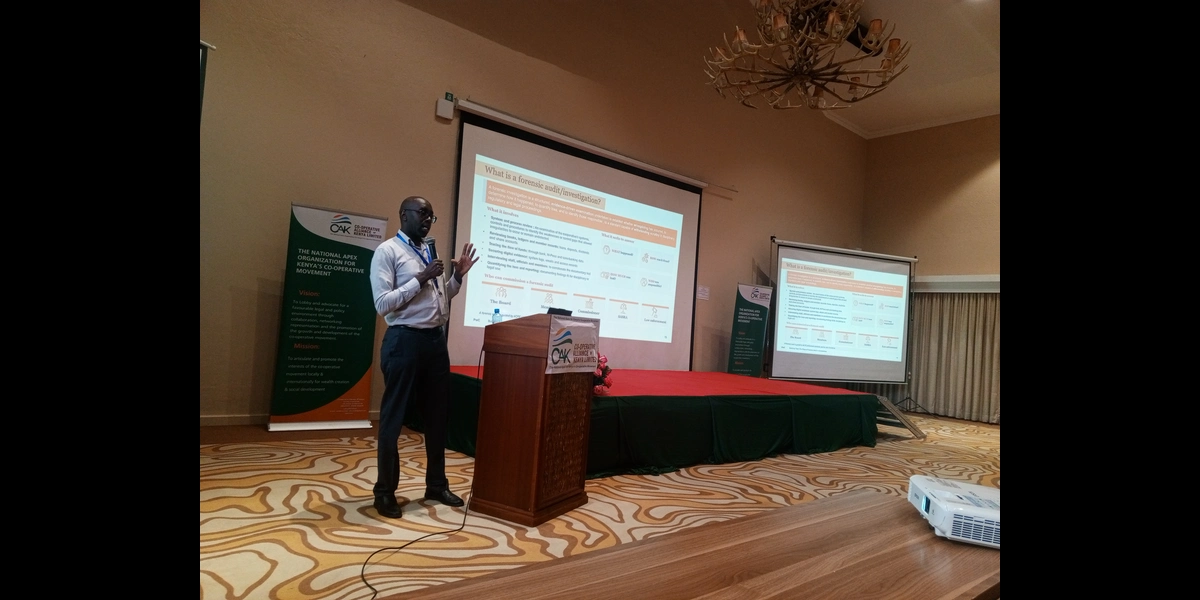
Photo courtesy: Photo courtesy
Trust is the foundation on which the co-operative movement is built.
Members entrust their savings, investments and financial future to institutions they collectively own. They expect their SACCOs and co-operative societies to be well governed, financially sound and accountable. When that trust is weakened, the consequences go beyond a financial loss. Members begin to question management, boards, auditors and, ultimately, the institution itself.
This is why forensic audit is becoming an increasingly important tool in the co-operative movement.
At the Co-operative Alliance of Kenya Future-Ready Co-operatives Leadership Forum, John Kamau, Forensics Leader at PwC Eastern Africa, examined the growing demand for forensic audits and their role in rebuilding confidence in co-operatives.
His central message was clear: a forensic audit is not simply another audit. It is an investigative process designed to establish what happened, how it happened, who was involved and, where possible, quantify the impact.
1. Why is the demand for forensic audits rising?
The growing demand for forensic audits is closely linked to a broader breakdown of trust.
Across the country, concerns about fraud, corruption, financial mismanagement and weak accountability have increased the pressure on institutions to demonstrate that they are acting in the interests of their stakeholders.
Co-operatives are not immune.
Members are increasingly asking difficult questions about how their money is managed. They want to know whether loans are being issued properly, whether procurement processes are fair, whether investments are genuine, whether financial records accurately reflect the institution's position and whether management and boards are exercising their responsibilities appropriately.
As these concerns grow, so does the demand for independent investigations.
Why are members demanding forensic audits?
According to Kamau's presentation, three broad concerns are driving this demand:
Governance concerns.
Members may suspect that established governance procedures are not being followed or that individuals are exercising authority without adequate oversight.
Financial concerns.
Unexplained losses, irregular transactions, questionable expenditures, loan arrears or inconsistencies in financial records can trigger demands for investigation.
Trust and accountability.
Members ultimately want assurance that those entrusted with their institution are accountable for their decisions and actions.
A forensic audit can provide an independent examination when ordinary assurance mechanisms are no longer sufficient to answer the questions being raised.
2. Not every problem requires a forensic audit
One of the important distinctions raised by Kamau is that there are different types of audits and oversight mechanisms, each designed to address different questions.
A statutory external audit is normally concerned with providing an independent opinion on financial statements.
An internal audit or supervisory committee review focuses on internal controls, risk management, compliance and operational processes.
Regulatory supervision and inspection provides oversight from the relevant regulator.
A Commissioner's inquiry can be used where there are serious concerns requiring formal investigation under the applicable co-operative framework.
A Commissioner's impromptu inspection provides another mechanism for checking the affairs and operations of a society.
There can also be specialised reviews such as:
- System and IT audits, which examine information systems and technology controls.
- ESG and sustainability audits, which examine environmental, social and governance considerations.
- Forensic audits or investigations, which focus on suspected wrongdoing and seek to establish facts and evidence.
The distinction matters.
A financial audit can tell stakeholders whether financial statements fairly present the financial position of an organisation within the scope of the audit.
A forensic investigation asks a different set of questions.
What happened?
How did it happen?
Who was involved?
What evidence exists?
How much was lost or improperly gained?
Those are fundamentally investigative questions.
3. What is a forensic audit?
A forensic audit or investigation is an examination designed to identify, investigate and document suspected financial misconduct, fraud or other irregularities.
It combines financial analysis with investigative techniques.
The objective is not merely to identify an unusual transaction.
The investigator seeks to establish the story behind the transaction.
For example, if a SACCO discovers that a significant loan was issued to a borrower who appears not to qualify, a conventional audit may identify weaknesses in the loan approval process.
A forensic investigation goes further.
It may examine the loan application, approval documents, supporting security, system records, communications, bank transactions, relationships between the parties and the movement of funds.
The question becomes:
Was this simply an error, a control failure or deliberate misconduct?
That distinction is critical.
4. What does a good forensic audit entail?
A good forensic investigation requires much more than reviewing accounting records.
It requires a clear mandate, appropriate expertise, independence and a methodical approach to evidence.
Several elements are particularly important.
A clear scope
The organisation commissioning the investigation should clearly define the concerns that need to be investigated.
A vague mandate can produce a vague investigation.
Independence
The investigator should be sufficiently independent to examine the issues objectively, including allegations involving senior employees, management or board members.
Evidence
A forensic investigation must be evidence-driven.
Documents, financial records, system logs, emails, contracts, approvals, transaction records and other relevant information may all become important.
Data analysis
Modern investigations increasingly rely on data analytics to identify unusual patterns, relationships and transactions that may not be obvious from manually reviewing thousands of records.
Interviews
People involved in the transactions can provide important information about how decisions were made and how processes actually operated.
Documentation
The findings need to be properly documented so that the organisation can understand what was investigated, what evidence was considered and how conclusions were reached.
Quantification
Where financial loss is established, the investigation may also seek to determine the value of the loss.
5. What a forensic audit is not
A forensic audit should not be viewed as a weapon for settling internal disputes.
It should not be commissioned simply because one faction of members disagrees with another.
It is also not a substitute for ordinary governance.
Boards cannot wait for a forensic investigation to discover weaknesses that effective internal controls should have prevented.
Nor should every accounting error automatically become a fraud investigation.
There is an important difference between:
an error,
a control weakness,
poor management,
and
deliberate misconduct.
A properly designed investigation seeks to establish the facts rather than begin with a predetermined conclusion.
6. How should a co-operative appoint a forensic auditor?
Kamau's presentation outlined three broad stages: commissioning, execution and post-investigation.
Commissioning
Before appointing a forensic auditor, the co-operative should establish why the investigation is required.
What are the allegations?
What period should be covered?
Which transactions or departments are involved?
What information is available?
Who has authority to commission the investigation?
The terms of reference should be carefully developed.
The co-operative should also consider the investigator's experience, independence, technical capability and ability to handle sensitive information.
Execution
Once appointed, the forensic team gathers and analyses relevant evidence.
This may include financial records, electronic data, procurement documents, loan files, contracts, bank records, system information and interviews.
The investigation should follow the evidence rather than assume the outcome.
Post-investigation
The investigation should result in clear findings and recommendations.
Where wrongdoing has been established, the organisation needs to consider the appropriate next steps.
These may include recovery efforts, disciplinary action, strengthening controls, regulatory reporting or legal action, depending on the circumstances.
Perhaps most importantly, the co-operative should ask:
How did our systems allow this to happen?
Finding an individual responsible is important.
Fixing the weakness that allowed the problem to occur is equally important.
7. Where should co-operatives focus their forensic risk?
Several areas within co-operatives and SACCOs deserve particular attention.
Credit and loan portfolios
For many SACCOs, the loan book represents their largest financial asset.
It can therefore also present significant risk.
Forensic reviews may be necessary where there are concerns about:
- Loans issued outside approved procedures
- Fictitious or questionable borrowers
- Inadequate security
- Irregular loan approvals
- Preferential treatment
- Manipulation of loan records
- Conflict of interest
- Unusual write-offs
- Rescheduling or restructuring of loans without proper justification
A healthy loan book requires more than good repayment rates. The underlying approval and monitoring processes must also be sound.
8. Accounting records
Financial records tell the story of a co-operative.
But if those records are manipulated, incomplete or inaccurate, management and members can make decisions based on a false picture.
Forensic attention may therefore be required where there are unexplained balances, unusual journal entries, suspicious payments, unsupported expenses, unexplained reconciliations or inconsistencies between different records.
The question is not simply whether the numbers balance.
It is whether the numbers represent reality.
9. Investments
Investment decisions can expose co-operatives to substantial financial and governance risks.
A forensic review may become necessary where questions arise over:
- The legitimacy of an investment
- The valuation of an asset
- The ownership of an investment
- Approval processes
- Conflicts of interest
- Related-party transactions
- Funds transferred to questionable entities
- Investments that cannot be adequately supported by documentation
Boards need to understand that investment decisions are not only financial decisions.
They are governance decisions.
10. Procurement
Procurement is another area that requires strong controls.
Red flags can include repeated awards to the same suppliers, inflated prices, unexplained variations, conflicts of interest, inadequate competition, incomplete documentation or payments for goods and services that were never properly delivered.
A procurement investigation should not focus only on the supplier.
It should examine the entire process—from the initial need and specifications through evaluation, approval, delivery and payment.
11. Cybersecurity is now part of forensic risk
The digital transformation of SACCOs has created enormous opportunities, but it has also changed the nature of financial crime.
Member information, financial records, transaction systems and digital channels can all become targets.
Cybersecurity therefore needs to be considered within the broader forensic risk framework.
A cyber incident can result in financial loss, data theft, manipulation of records or unauthorised transactions.
Co-operatives need controls that protect not only physical documents and cash but also data and digital systems.
12. The forensic audit should not be the first line of defence
Perhaps the most important lesson from the discussion is that forensic audits should not replace good governance.
They should complement it.
A co-operative that has strong governance, effective internal controls, transparent financial reporting, robust procurement systems and active oversight is less likely to require a forensic investigation in the first place.
This leads to three important priorities for the movement.
Strengthen governance
Boards must understand their oversight responsibilities.
Management must operate within approved policies.
Committees must perform their functions effectively.
And members must exercise their rights to demand accountability.
Enhance financial transparency
Financial information should be accurate, timely and understandable.
Members should not have to wait for a crisis before asking where their money has gone.
Transparency creates an environment where irregularities are more difficult to conceal.
Rebuild member confidence
At the centre of the co-operative model is the member.
When members lose confidence, even a financially strong institution can face serious reputational damage.
Restoring confidence requires more than saying that everything is fine.
It requires evidence.
13. Building trust beyond the forensic audit
A forensic investigation can establish facts.
It can identify weaknesses.
It can quantify losses.
It can provide evidence.
But a forensic audit alone cannot rebuild a co-operative.
That requires action after the investigation.
If weaknesses are identified, they must be corrected.
If controls are inadequate, they must be strengthened.
If governance structures are not working, they must be improved.
If members have lost confidence, leadership must engage them openly and transparently.
And where wrongdoing is established, appropriate action must follow.
The ultimate objective should therefore not be to conduct more forensic audits.
It should be to build organisations that need fewer forensic investigations because their governance and control systems work.
The future of trust in the co-operative movement
Kenya's co-operative movement manages significant resources on behalf of millions of members. With that responsibility comes an equally significant obligation to protect those resources.
Trust cannot be demanded from members.
It has to be earned.
It is earned through transparent financial reporting, responsible leadership, strong internal controls, effective oversight and accountability.
Forensic audit has an important role to play when trust has been compromised or serious concerns arise. It provides a structured way of moving beyond suspicion and towards evidence.
But the bigger opportunity for the co-operative movement lies beyond the investigation itself.
It lies in building institutions where good governance prevents problems, transparency exposes problems early and accountability ensures that problems are addressed.
That is how forensic audit can contribute to the bigger goal: building trust in Kenya's co-operative movement.