
Co-operatives Urged To Look Beyond Traditional Investments As Ithondeka Advocates Strategic Asset Allocation
By Admin Tuesday, 8th September 2026
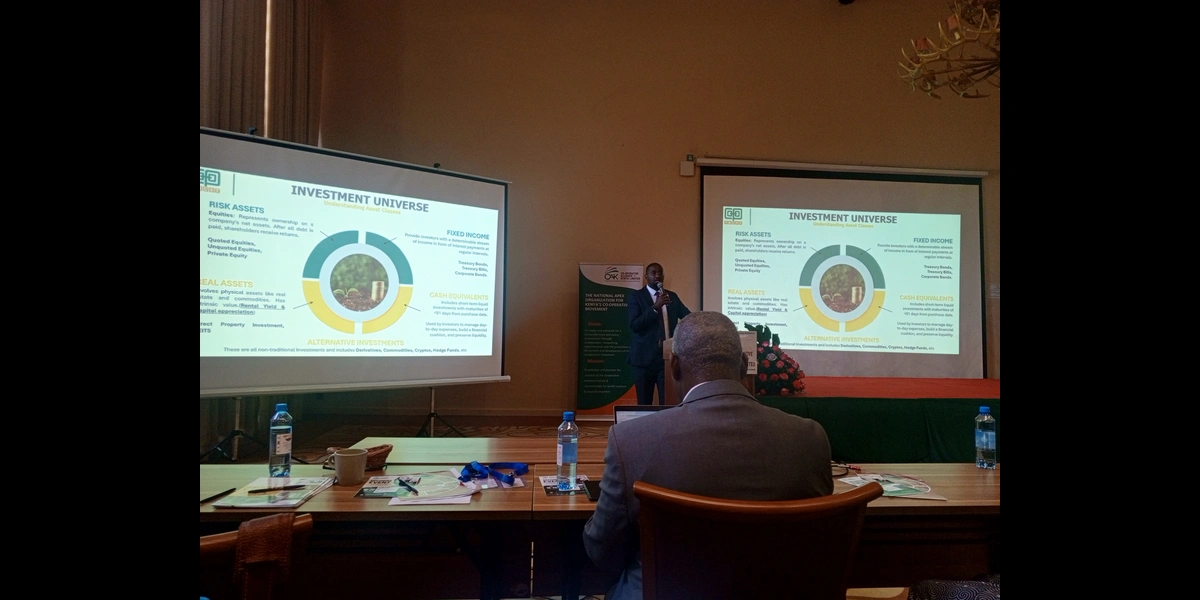
Photo courtesy: Photo courtesy
Co-operatives and SACCOs need to rethink how they invest their funds and adopt more deliberate strategies that balance returns, risk and long-term institutional objectives, Nicholas Ithondeka of Co-op Trust told leaders during the Future-Ready Co-operatives and SACCOs Leadership Forum.
Ithondeka took co-operative leaders through the alternative investment universe, highlighting different asset classes available to institutions seeking to grow and preserve their funds.
He identified four broad categories that investors need to understand: risk assets, real assets, fixed income and cash equivalents.
The presentation challenged co-operative leaders to move away from making investment decisions based simply on what appears popular in the market and instead develop structured investment strategies based on their specific objectives and risk tolerance.
Understanding the investment universe
According to Ithondeka, the investment landscape offers institutions a range of opportunities, but each comes with different characteristics and levels of risk.
Risk assets can offer higher potential returns but may also expose investors to greater volatility. Real assets provide another investment avenue, while fixed-income investments and cash equivalents can play important roles in liquidity management and portfolio stability.
For co-operatives managing members' funds, understanding the differences between these asset classes is critical before committing money to any particular investment.
The objective should not simply be to find the investment offering the highest return, but to construct a portfolio that is appropriate for the institution's objectives and ability to withstand losses or fluctuations.
Avoiding the herd mentality
One of the pitfalls Ithondeka highlighted when choosing investments is herd mentality—the tendency for investors to follow what everyone else appears to be doing.
An investment can become attractive simply because other institutions or investors are putting their money into it. But popularity alone does not make an investment suitable for every SACCO or co-operative.
For institutional investors, investment decisions should therefore be based on analysis, objectives and risk considerations rather than following market trends blindly.
The challenge for boards and investment committees is to ask: Does this investment make sense for our institution, or are we investing because everyone else is doing it?
The importance of Strategic Asset Allocation
Ithondeka introduced leaders to Strategic Asset Allocation (SAA) as a structured approach to determining how an institution should distribute its investments among different asset classes.
Rather than repeatedly deciding where to put money whenever an investment opportunity emerges, an SAA provides a strategic framework for determining the appropriate mix of investments.
The process begins with understanding what the institution wants to achieve.
Five steps to developing an SAA plan
Ithondeka outlined key steps that institutions can follow when developing a Strategic Asset Allocation plan.
1. Define investment objectives
The institution must first establish what it wants its investments to achieve. Objectives provide the foundation for all subsequent investment decisions.
2. Assess risk tolerance
Different institutions have different capacities and willingness to take risks. Understanding risk tolerance helps determine how much exposure an institution should have to different asset classes.
3. Set the investment time horizon
Investment decisions should consider how long the funds can remain invested. An institution investing money that may be required in the short term will have different needs from one investing for long-term objectives.
4. Determine asset allocation weights
Once objectives, risk tolerance and time horizon are understood, the institution can determine how much of its portfolio should be allocated to different asset classes.
5. Apply diversification strategies
Diversification helps reduce overdependence on one investment or asset class. Instead of putting too much money in one area, institutions can spread their investments across suitable opportunities.
Choosing the right investment partner
Beyond deciding where to invest, Ithondeka emphasised the importance of building a strong investment partnership.
The choice of an investment partner should not be based solely on promises of high returns. Co-operatives should undertake due diligence and consider the capability and credibility of the organisation they intend to work with.
Among the issues to consider are the team, domicile and track record of the investment partner.
A strong and respectable professional team is particularly important because investment decisions require expertise, discipline and proper management of risk.
For co-operative leaders, this means looking beyond the investment product itself and examining who is managing the money, their professional capacity, their history and the environment in which they operate.
Investment products for the co-operative movement
Ithondeka also highlighted the need for investment products designed with the needs of the co-operative movement in mind.
Co-operatives control significant pools of capital, and the way these funds are invested can influence their financial strength and their ability to meet institutional and member objectives.
The discussion therefore encouraged leaders to think strategically about their investment portfolios rather than treating investment as an occasional financial decision.
His message to the movement was ultimately about being informed, disciplined and courageous in investment decision-making.
As Ithondeka put it: “Fortune favours the brave.”
But in the context of institutional investing, being brave does not mean taking unnecessary risks. For SACCOs and co-operatives, it means being willing to explore suitable investment opportunities while having a clear strategy for managing the risks involved.
A future-ready co-operative, therefore, needs more than money to invest. It needs clear objectives, an understanding of risk, a defined investment horizon, diversification, strategic asset allocation and a credible investment partner.