
Deposit-taking Saccos Strengthen Financial Resilience And Operational Efficiency In 2025
By Admin Saturday, 17th October 2026
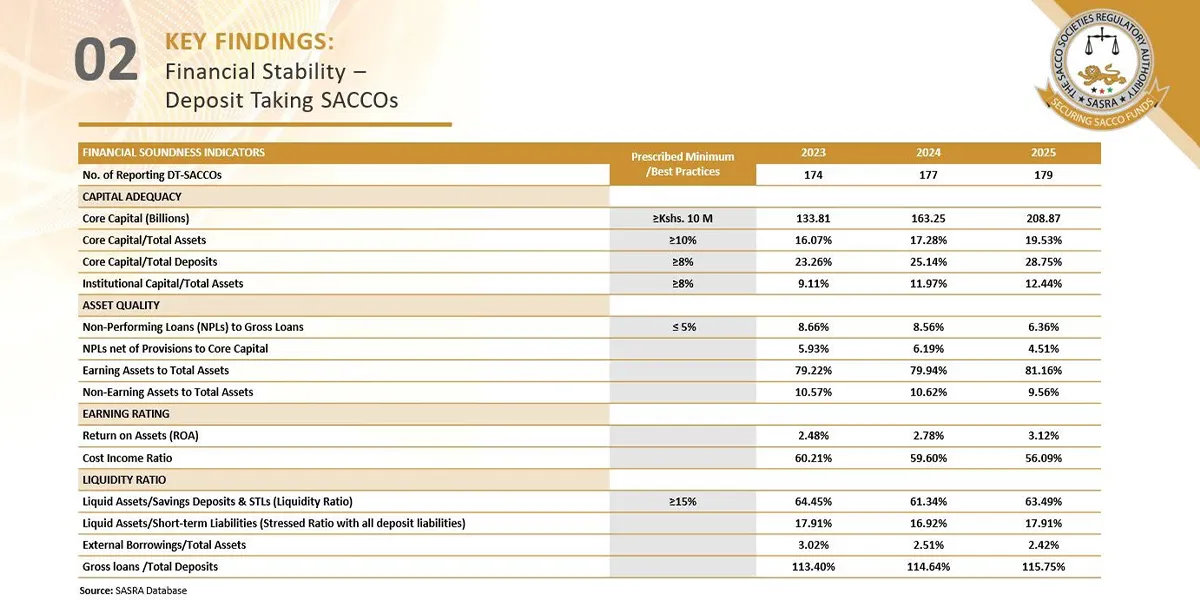
Photo courtesy: SASRA
Kenya’s Deposit-Taking Savings and Credit Cooperative Societies (DT-SACCOs) recorded notable improvements in key financial soundness indicators in 2025, pointing to a sector that is becoming stronger, more resilient and better positioned to meet the financial needs of its members.
According to financial soundness indicators published by the Sacco Societies Regulatory Authority (SASRA), the sector registered significant growth in core capital, maintained a strong liquidity position, improved operational efficiency and recorded better asset quality during the year.
The number of reporting Deposit-Taking SACCOs also increased from 177 in 2024 to 179 in 2025, providing an indication of continued activity and growth within the regulated DT-SACCO sector.
Strong Growth in Core Capital
One of the most significant developments in 2025 was the growth in core capital among Deposit-Taking SACCOs. Core capital increased from Ksh 163.25 billion in 2024 to Ksh 208.87 billion in 2025, representing an increase of approximately 28 per cent.
The substantial increase strengthens the financial foundation of the sector and enhances the ability of SACCOs to absorb unexpected financial pressures while continuing to support their operations.
Core capital is an important measure of financial strength because it provides a cushion against potential losses and other financial shocks. The increase recorded in 2025 therefore represents an important development for the stability of Deposit-Taking SACCOs and the members who rely on them for savings, credit and other financial services.
The sector also remained comfortably above the prescribed minimum requirements across several capital adequacy indicators. Core capital to total assets increased from 17.28 per cent in 2024 to 19.53 per cent in 2025, compared with a prescribed minimum of 10 per cent.
Similarly, core capital to total deposits increased from 25.14 per cent to 28.75 per cent, well above the prescribed minimum of 8 per cent. Institutional capital to total assets also improved from 11.97 per cent in 2024 to 12.44 per cent in 2025, against a minimum requirement of 8 per cent.
These indicators point to an increasingly solid capital position within the sector.
Healthy Liquidity Position
Liquidity remained another important area of strength for DT-SACCOs in 2025. The sector recorded a liquidity ratio of 63.49 per cent, compared with 61.34 per cent in 2024.
The ratio was significantly above the prescribed minimum of 15 per cent, demonstrating the sector’s strong capacity to meet short-term financial obligations.
For SACCO members, liquidity is particularly important because it supports the ability of institutions to honour withdrawals and other short-term obligations when they fall due. A strong liquidity position can also contribute to confidence among members and depositors.
The improvement from 61.34 per cent to 63.49 per cent therefore represents a positive development, particularly in an environment where financial institutions must maintain sufficient liquid resources while also putting funds to productive use.
The liquid assets to short-term liabilities ratio, measured under stressed conditions involving all deposit liabilities, stood at 17.91 per cent in 2025, recovering from 16.92 per cent in 2024. This further highlights the sector’s capacity to manage short-term liquidity pressures.
Improved Operational Efficiency
The 2025 results also point to improvements in how DT-SACCOs managed their operating costs.
The cost-income ratio declined from 59.60 per cent in 2024 to 56.09 per cent in 2025. A lower cost-income ratio generally indicates improved efficiency because a smaller proportion of income is being consumed by operating expenses.
In practical terms, the improvement means that SACCOs were able to generate income while allocating a smaller share of that income towards running their operations.
Operational efficiency is increasingly important for SACCOs as they seek to remain competitive, expand their services and respond to changing expectations among members. Improved efficiency can create greater room for institutions to invest in technology, strengthen service delivery and improve their overall financial performance.
The improvement recorded in 2025 therefore complements the sector’s strong capital and liquidity position, creating a broader picture of financial strengthening.
Improved Returns from Assets
The sector also recorded an improvement in its ability to generate returns from its assets.
Return on Assets (ROA) increased from 2.78 per cent in 2024 to 3.12 per cent in 2025. The improvement indicates stronger earnings performance relative to the assets held by Deposit-Taking SACCOs.
At the same time, earning assets increased from 79.94 per cent of total assets in 2024 to 81.16 per cent in 2025. This suggests that a greater proportion of the sector’s assets were deployed in activities capable of generating income.
The combination of higher earning assets and improved ROA points towards stronger utilisation of resources during the year.
Progress in Asset Quality
Another encouraging development was the improvement in the quality of the sector’s loan portfolio.
The ratio of Non-Performing Loans (NPLs) to gross loans declined from 8.56 per cent in 2024 to 6.36 per cent in 2025. Although the ratio remained above the prescribed maximum of 5 per cent, the reduction represents meaningful progress in the management of credit risk.
The reduction in NPLs suggests that the sector made progress in addressing loans that were not performing as expected. Effective management of loan portfolios remains critical to the financial health of SACCOs because lending is a major component of their operations.
Further improvement in asset quality will therefore remain important for strengthening the sector and ensuring that funds entrusted to SACCOs continue to support productive lending.
The ratio of NPLs net of provisions to core capital also improved, falling from 6.19 per cent in 2024 to 4.51 per cent in 2025. This provides another indication of improvement in the sector’s capacity to absorb potential losses associated with non-performing loans.
Meanwhile, non-earning assets declined from 10.62 per cent of total assets in 2024 to 9.56 per cent in 2025, further supporting the overall improvement in asset utilisation.
Continued Financial Strengthening
The 2025 financial soundness indicators present a generally positive picture of Kenya’s Deposit-Taking SACCO sector. The substantial increase in core capital, strong liquidity position, improved cost efficiency, higher return on assets and reduction in non-performing loans all point towards important progress.
At the same time, the indicators highlight areas that require continued attention. In particular, the NPL-to-gross-loans ratio of 6.36 per cent remained above the prescribed maximum of 5 per cent, underscoring the need for continued focus on credit management and asset quality.
The sector also recorded an increase in the gross loans-to-total deposits ratio, rising from 114.64 per cent in 2024 to 115.75 per cent in 2025. This reflects the significant role that member deposits continue to play in supporting lending activities.
Overall, the 2025 performance demonstrates a Deposit-Taking SACCO sector that is strengthening its financial base while improving efficiency and managing risks. The growth in capital provides greater resilience, the strong liquidity position supports the ability to meet short-term obligations, and the improvement in operational efficiency demonstrates progress in managing costs.
For millions of Kenyans who rely on SACCOs for savings, credit and financial services, the continued strengthening of Deposit-Taking SACCOs remains important. A financially sound SACCO sector provides a stronger foundation for sustainable growth, responsible lending and improved services to members.
As the sector moves forward, maintaining adequate capital, strengthening liquidity management, improving asset quality and sustaining operational efficiency will remain critical to ensuring that Deposit-Taking SACCOs continue to play their important role in Kenya’s financial sector.